
· Xavier Fàbregas · 4 min read
Who Pays for the Party
An exponential and indefinite increase in the M2 money supply generates significant macroeconomic imbalances. Inflation is the typical consequence of uncontrolled money printing. We analyze the relationship between monetary expansion, asset bubbles, cryptocurrencies, and sovereign debt.
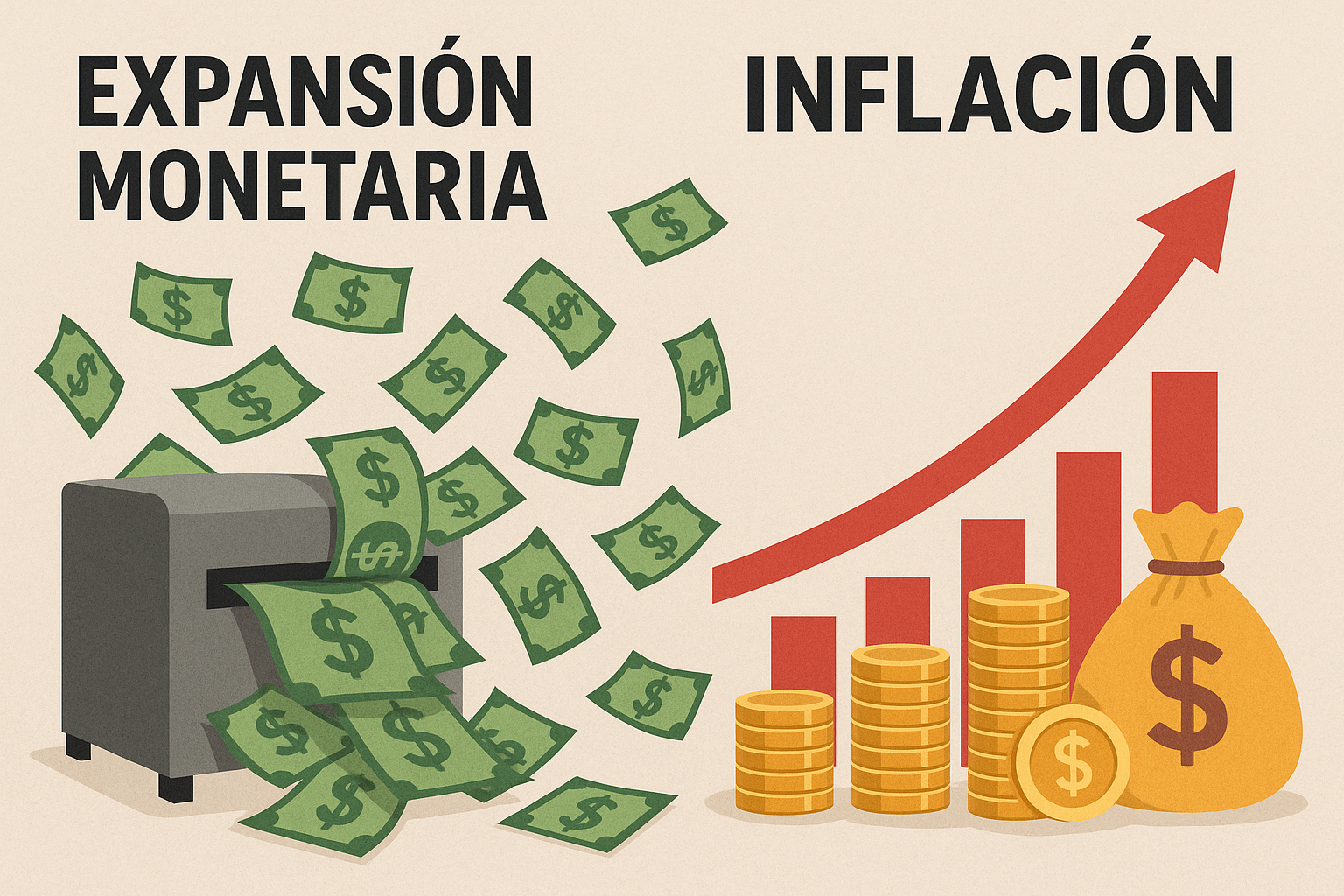
Explosive M2 Growth and Macroeconomic Imbalances
An exponential and indefinite increase in the M2 money supply (banknotes, coins, and liquid deposits) typically generates significant macroeconomic imbalances. In classical monetary theory (the quantity equation MV = PQ), if the amount of money grows much faster than production, prices will tend to rise sooner or later. Inflation is the typical consequence of uncontrolled money “printing,” although it may manifest with a certain time lag. Milton Friedman argued that “inflation is always and everywhere a monetary phenomenon.”
Recent US experience illustrates this relationship: after the massive liquidity injection in 2020-2021 (M2 grew more than 25% annually), inflation surged to 40-year highs around 2022. As M2 expansion moderated, inflation also began to decline with a few months’ delay. There is a lag of several quarters between excess money and price increases, but in the long run inflationary pressure eventually surfaces.
Beyond the loss of purchasing power, monetary mismanagement erodes confidence in the currency and can destabilize other macro equilibria. If M2 growth is permanent and out of control, economic agents could anticipate higher future inflation and demand higher interest rates, depreciating the currency. In extreme cases, the spiral can lead to hyperinflation and monetary collapse.
History offers cautionary examples: after financing public spending by printing money, Germany (Weimar) in 1923, Zimbabwe, and Argentina suffered catastrophic hyperinflations. In Argentina, the continuous monetization of the fiscal deficit by the central bank led to annual inflation of 276% in 2023.
Impact on Capital Markets and Asset Bubble Formation
Abundant liquidity from monetary expansion tends to inflate capital markets. When central banks flood the system with money, interest rates fall and investors seek higher returns in stocks, real estate, or other assets, driving their prices above what fundamentals justify.
The so-called “global liquidity” has been found to largely explain several pre-crisis financial phenomena: stock market rallies, falling bond yields, real estate booms, surging international capital flows, and even inflation spikes were all linked to excess liquidity before 2008.
Several economists argue that in recent decades money creation has ended up mainly “trapped in financial markets, generating asset inflation rather than real growth.” Between March 2020 and March 2021, M2 grew approximately $5.3 trillion (+35%) thanks to monetary policy and fiscal stimulus. This enormous flow of liquidity drove up stock, bond, and housing prices.
The indefinite expansion of M2 distorts capital markets: it creates artificial booms followed by sharp corrections, increasing volatility and systemic risk.
The Rise of Cryptocurrencies and Alternative Assets
In the current context, marked by distrust of traditional currencies due to money “printing,” many investors have turned their attention to alternative assets such as cryptocurrencies, gold, or other stores of value. Bitcoin was born with the promise of being inflation-resistant “digital gold” given its limited supply.
There is evidence that Bitcoin behaves as a “barometer of global liquidity”: analysts have quantified that liquidity movements explain up to 90% of the variation in Bitcoin’s price and nearly 97% of the Nasdaq.
It is important to note that cryptocurrencies carry their own volatility and risks: part of their 2020-21 boom is explained by excessive liquidity and speculative appetite, and when monetary policy tightened in 2022, Bitcoin fell more than 70% from its peaks.
Runaway Debt, Fiscal Monetization, and Long-Term Inflation
The US case is particularly relevant: federal debt now exceeds 100% of GDP and continues growing without a clear containment plan. There is a close relationship between chronic deficits, monetization, and price increases.
Economists speak of “fiscal dominance” when monetary policy becomes subordinate to financing the treasury. In such situations, the central bank’s priority shifts from price stability to sustaining public spending, whereupon inflation typically spirals out of control.
Medium and Long-Term Outlook
If the money supply continues to expand unchecked and debt keeps accumulating, the outlook is not encouraging. In the medium term, the most likely scenario is chronically elevated inflation. In the long term, continued imprudent M2 increases risk something even more structural: a loss of global confidence in the dollar and US debt.
Conclusion
There is a strong relationship between M2 and inflation over the medium-to-long term, especially when monetary expansion is used to finance permanent deficits. There is no “free lunch” in indefinite money printing. As research from the St. Louis Fed suggests, even with delays, inflation ends up following the trajectory of the money supply.
Sources: Studies and data from the Federal Reserve Bank of St. Louis, Dallas Fed, Cato Institute blog, FS Investments analysis, among others.